The Char Dham Yatra is a sacred pilgrimage that holds immense significance for Hindus across the world. It is widely known as a journey to four revered sites: Badrinath, Rameshwaram, Puri, and Dwarka. These sites are believed to offer the path to spiritual liberation, or moksha. However, there is a lingering question among devotees – why is Kedarnath not included in the Char Dham?
In this article, we will delve into the fascinating reasons why Kedarnath holds its own unique significance outside of the traditional Char Dham circuit and unveil its special place in Hindu mythology.
Historical and Mythological Background of Kedarnath:

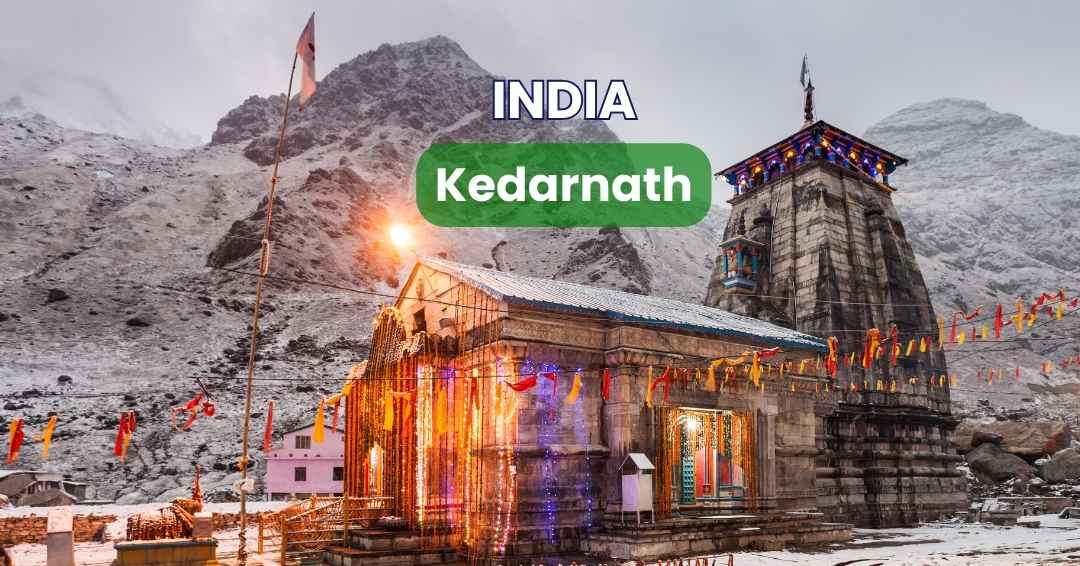
Kedarnath, nestled amidst the majestic Himalayas in Uttarakhand, has its roots deeply embedded in ancient Hindu scriptures and legends. The origins of Kedarnath can be traced back to the Mahabharata epic, where it is believed that the Pandavas sought Lord Shiva’s blessings at this sacred site after the great Kurukshetra war.
According to the legend, after the Kurukshetra war, the Pandavas sought penance to absolve themselves of the sins committed during the battle. They sought Lord Shiva’s blessings to attain salvation. Lord Shiva, not wanting to be easily found, took the form of a bull and went into hiding in the Garhwal region of the Himalayas.
The Pandavas, determined to find Lord Shiva, followed him to Kedarnath, where they finally recognized him. It is believed that the temple of Kedarnath stands at the same spot where the Pandavas built a shrine to worship Lord Shiva and receive his blessings.
Thus, the origin of Kedarnath is deeply intertwined with the Pandavas’ devotion and their quest for redemption.
Significance of Kedarnath as a Jyotirlinga:

Kedarnath holds great reverence as one of the twelve Jyotirlingas, the sacred representations of Lord Shiva spread across India. Jyotirlingas are believed to be self-manifested lingams that emit divine light, symbolizing the infinite cosmic energy of Lord Shiva. The presence of Kedarnath as a Jyotirlinga further accentuates its significance as a standalone pilgrimage site, separate from the Char Dham.
The idea of formation of Char Dham:

Adi Shankaracharya, a renowned Indian Vedic Scholar of 8th Century, defined the Char Dham as four significant Hindu pilgrimage sites. These sacred abodes are intricately connected to four different eras: Badrinath representing Satya Yuga, Rameswaram symbolizing Treta Yuga, Dwaraka embodying Dwapara Yuga, and Jagannatha Puri representing Kali Yuga.
The concept of the Char Dham was to designate four significant sites across the country, each associated with Lord Vishnu and his different incarnations. Lord Vishnu, in his various incarnations, is believed to take a holy bath in Rameswaram, engage in meditation in Badrinath, partake in divine meals in Puri, and find repose in Dwarka.
Explanation for Kedarnath’s exclusion:

Badrinath has been acknowledged as one of the Char Dhams, as it is represented as the dham of Satya Yuga. In contrast, Kedarnath is often regarded as its counterpart, forming an integral part of the pilgrimage journey.
According to mythology, Lord Vishnu and Lord Shiva are depicted as eternal companions, often termed as Hari – Hara. It is believed that wherever Lord Vishnu resides, Lord Shiva is present in close proximity. The Char Dham follows this believe. This is the reason Kedarnath is considered as the pair of Badrinath.
Similarly, Sri Ranganathaswamy Temple is regarded as the counterpart of Rameswaram, while Somnath Jyotirlinga is considered the companion of Dwaraka and Lingaraj Temple is considered as the pair of Jagannath Temple, Puri.
Conclusion:

While Kedarnath is not officially part of the Char Dham circuit, it stands as a revered pilgrimage destination in its own right. With its deep-rooted mythological significance, being a Jyotirlinga, and offering a unique spiritual experience, Kedarnath holds a special place in the hearts of devotees.
However, Kedarnath is part of a smaller pilgrimage circuit in Uttarakhand, known as the Chota Char Dham, which collectively includes Yamunotri, Gangotri, Kedarnath, and Badrinath.
As pilgrims embark on their sacred journey to Kedarnath, they embrace the divine energy, seek blessings from Lord Shiva, and unravel the mystical wonders of this sacred abode in the Himalayas.
Image Credits: Canva
![Read more about the article Explore the Mystical Char Dham in Namchi, Sikkim [2023]](https://traveltalesclub.com/wp-content/uploads/2023/07/Char-Dham-Namchi-www.traveltalesclub.com_-300x157.jpg)

