Slow travel is trending, and honestly, it’s the best way to enjoy a place. I realized this when I visited Hawa Mahal in Jaipur and decided not to rush. No checklist, no pressure to hop to the next tourist spot. Just a relaxed day, soaking in every detail.
This isn’t just another travel blog. I want to show you how to explore Hawa Mahal like a local — slowly, deeply, and with stories hidden behind every wall and window.
I was staying at Hotel Metro Inn, a clean and comfortable place conveniently located near Jaipur Railway Station and just a short walk from the Railway Station metro. Its location gave me the idea to explore the city like a local.
Hawa Mahal has two tourist entrances – the main entrance through the rear side of the City Palace complex (commonly used by most visitors), and another smaller access from the Tripolia Bazar side.
If you’re coming by metro, the Badi Chaupar station is your best bet, it drops you right near the quieter entrance. If you’re arriving by road or auto, Tripolia Bazar Gate is closer and easier to spot.
Metros are quick, convenient, and traffic-free mode of exploring a city. The ride from Railway Station to Badi Chaupar cost just ₹15. It took around 20 minutes to reach.
I visited on a weekday, and there was still a queue for tickets. Thankfully, I had purchased the composite ticket online and could skip the line. I’d definitely recommend getting one — it makes things much easier.

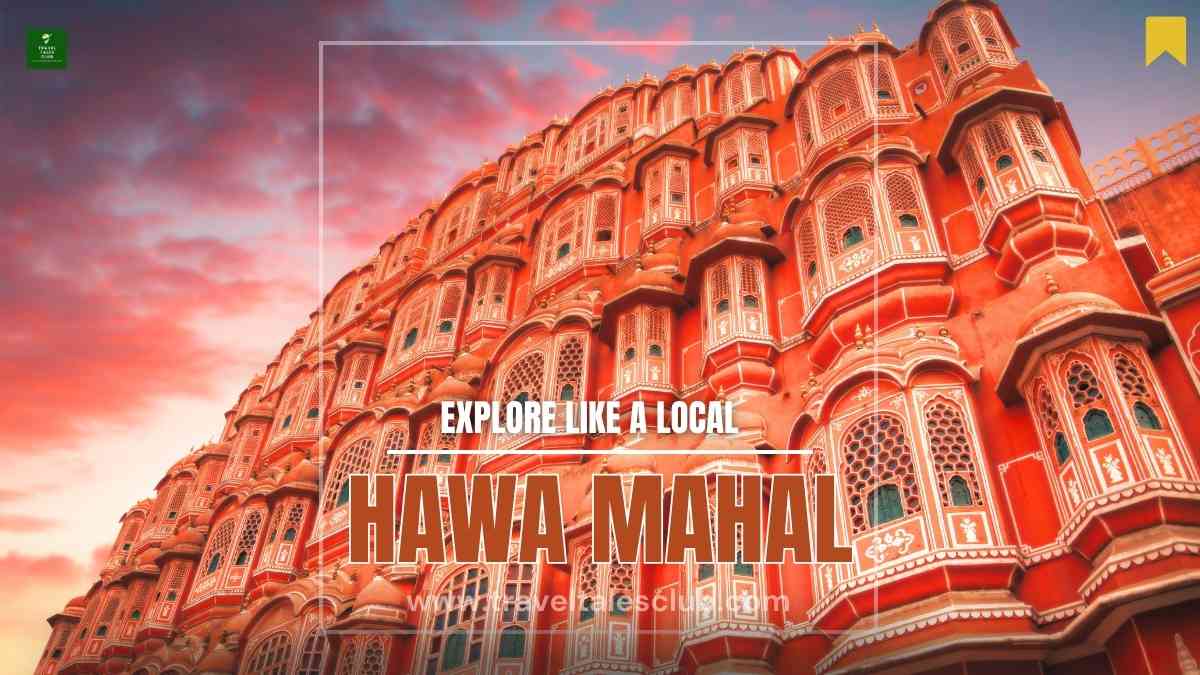
As you make your way in, you’ll be surprised to find that the iconic façade you see from the street, with its honeycomb of windows and red sandstone glow, isn’t the entrance at all. The actual access point is from the back lane, and it feels like you’re slipping into a secret.

Hawa Mahal had looked so grand and towering from the outside — but from within, it felt almost the opposite. Narrow corridors, sloping ramps, and small rooms unfolded one after another, quietly leading me upward. There was no typical palace grandeur here, no lavish throne room — and that’s exactly what made it special.

Hawa Mahal was built in 1799 by Maharaja Sawai Pratap Singh, designed by brilliant architect of the time, Lal Chand Ustad, and constructed as an extension of the royal zenana (women’s quarters) of the City Palace. The façade resembles Lord Krishna’s crown — a tribute to the king’s devotion.

This was not a palace meant for living. It was a viewing gallery, crafted so that royal women could quietly observe festivals, processions, and daily life in the bustling streets of Jaipur without being seen.
Interestingly, Hawa Mahal was built without any cement. Instead, it was constructed using traditional materials of the time — red and pink sandstone, lime mortar, and natural adhesives. Cement wasn’t used back then, and lime plaster was the preferred binding material because it allowed the structure to “breathe” naturally, expand with heat, and stay cool inside, especially in Rajasthan’s harsh climate.

Another surprising fact? Amazingly, Hawa Mahal has no building foundation. Yet it rises five stories high — making it the world’s tallest building without a foundation. Its curved, pyramidal shape helps evenly distribute weight and keep it stable and strong for over 200 years without any deep base or cement.

Each of the five levels has its own name and purpose:
- Sharad Mandir – the ground floor, used during autumn celebrations
- Ratan Mandir – where colored glass panels scatter sunlight across the floor
- Vichitra Mandir – a space where the king worshipped Lord Krishna
- Prakash Mandir – an open-air floor for natural light and breeze
- Hawa Mandir – the topmost floor, offering panoramic views and the best airflow
Surprisingly, you won’t find stairs inside Hawa Mahal. Instead, gently sloping ramps, connect all five floors, making it easier for royal women, often dressed in heavy traditional attire, to move between levels.

The air feels cooler with each step, and it is not just because of the weather. The design itself breathes. Tiny jharokhas — hundreds of them — let in streaks of light and soft currents of air. They create a natural Venturi effect, allowing cool air to flow through the entire structure, even on the hottest Rajasthan days.
I could feel the air on my face as I passed one after another. It’s hard to believe this five-storey marvel was built over 200 years ago — with no modern ventilation, yet still perfectly climate-conscious.

Some jharokhas are barely large enough to peek through, while others open like tiny windows. They all face the street — the perfect design for watching life unfold without being seen.
Small jharokhas: Used for ventilation and privacy; allowed women to peek out without being seen. Larger windows/balconies: Offered clear views for important events like royal processions or festivals.
Some windows also differ in size based on which floor you’re on — upper floors have smaller openings to reduce heat and sun exposure.

On the upper floors, some windows still have the original colored glass panes (in blues, greens, and reds). When sunlight filters through, it casts a soft, rainbow-like glow on the stone floors — a subtle yet magical detail many miss.
Despite being in the heart of the busy old city, once you’re inside the Mahal — especially on the upper floors — it’s eerily peaceful. The thick walls, narrow windows, and overall elevation cut out most of the city noise. It feels like a calm bubble suspended above Jaipur.
Some doors in Hawa Mahal are closed and locked, adding a sense of mystery. These likely lead to fragile or restricted areas, some connected to the City Palace, not meant for public viewing. Many upper rooms are shut for safety or preservation by the ASI (Archaeological Survey of India), and some doors were just passageways, not actual rooms.

The rooftop — the fifth and topmost floor of Hawa Mahal — offers more than just a breeze. From here, you get a panoramic view of the old city, with Jaipur’s bustling streets on one side and the Aravalli hills in the distance. It’s also a favorite photo spot — especially in the golden morning light.

On some days, you might even catch a touch of Rajasthani folk culture right inside the mahal. I came across a live puppet (kathputli) dance show and soft tunes of traditional music echoing through the open corridors — small touches that bring the space to life without disturbing its calm.

Before leaving, I spent a few quiet minutes on the ground floor, where a small museum is now set up. It showcases artifacts from Jaipur’s royal past, along with paintings and a statue of Maharaja Sawai Pratap Singh, the king who built Hawa Mahal. There’s even a replica model of the palace, which helps you understand its structure from a different perspective — especially after walking through its narrow ramps and breezy corridors.
It’s a humble museum, but worth a stop before stepping back into the city streets.
Essential Information:
- Visiting Hours: Daily from 9:00 AM to 5:00 PM (including Sundays and public holidays)
- Exploration Time: 45 min to 60 min
- Ticket Price (Indian Citizens): ₹50 for adults, ₹25 for students (with valid ID)
- Parking: Nearby parking available at Badi Chaupar or Ramniwas Bagh area
- Best Time to Visit: Morning (9–11 AM) for soft light and fewer crowds. Avoid midday heat during summer

Bonus tip:
Ever wondered how people get those perfect shots of Hawa Mahal’s honeycomb façade from above? Just across the road, a few rooftop cafés (like The Tattoo Café and Wind View Café) offer the ideal angle.
For a small token amount (usually adjusted with your food bill), they let you access the rooftop — a peaceful spot to take that postcard-perfect photo.
Hawa Mahal isn’t just something to see, it is something to feel. It is not about ticking it off your itinerary, but about slowing down, letting the breeze hit your face, and listening to the quiet stories tucked between its walls.
If you ever find yourself in Jaipur, take your time here. Don’t just pass by for a photo. Sit. Look out. Breathe.
You’ll leave with more than just pictures — you’ll carry a piece of the city’s soul with you.
![Read more about the article Rabindra Sarobar Lake, Kolkata – Best Things To Do [2023]](https://traveltalesclub.com/wp-content/uploads/2023/07/Rabindra-Sarovar-Kolkata-www.traveltalesclub.com_-300x157.jpg)