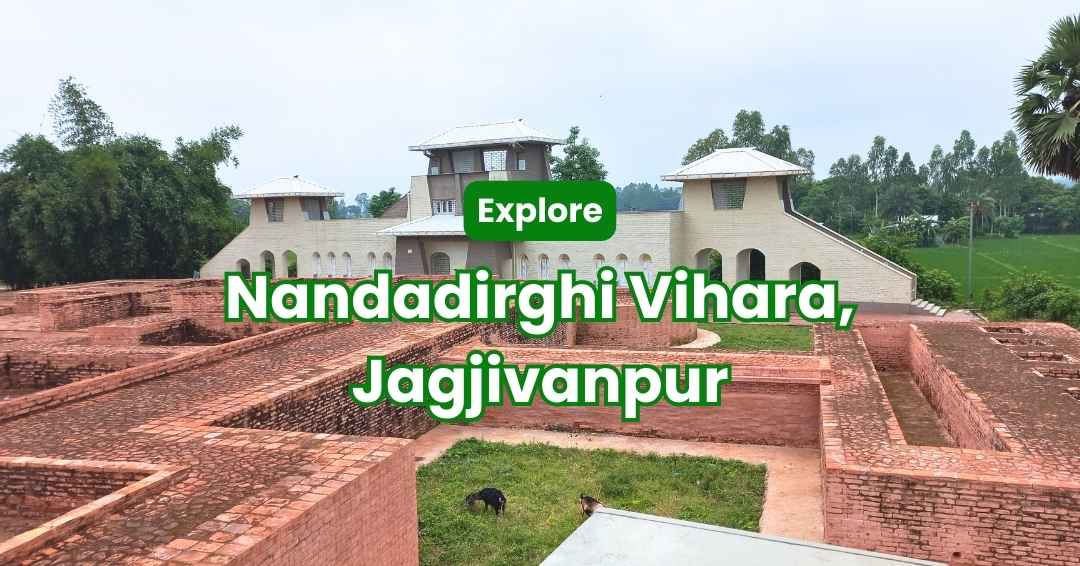
In the quiet embrace near West Bengal – Bangladesh Border, 42 Km from Malda, in Tulavita (Tulabhita), West Bengal, India, a hidden gem from the 9th century emerges as a testament to the grandeur of history and the legacy of a bygone era. Welcome to Jagjivanpur Nandadirghi Vihara, a Buddhist monastery that stands proudly as one of the most significant archaeological sites in the state.

As we journey through its storied past, we uncover not just the bricks and stones, but the heart and soul of a cultural heritage that has withstood the test of time. Join us on this exploration of a historical marvel that has captured the essence of Bengal’s rich history and continues to beckon curious souls from across the world.
1. A Glimpse into the Past
[1.1] Masterpiece of Pala-era Architecture

The vihara was built under the rule of the Pala dynasty, which was a powerful Buddhist empire that ruled over much of eastern India from the 8th to the 12th centuries. The Palas were patrons of Buddhism, and they built many monasteries and temples throughout their empire.
The Jagjibanpur Nandadirghi Vihara is one of the most important surviving examples of Pala-era Buddhist architecture. It was built by the Pala emperor Mahendrapala in 854 AD, for the purpose of promoting Buddhism and providing a place of learning for monks and students.

The items found at the Jagjibanpur Nandadirghi Vihara provide valuable information about the history of Buddhism in Bengal in the 9th century. The copper plate inscription is particularly important, as it is the only known charter granted by Mahendrapala to a Buddhist monastery. This inscription also mentions the name of the vihara’s founder, Vajradeva, who was a general in Mahendrapala’s army.
[1.2] Lost in Time – A Monastery’s Journey from Life to Ruins

The exact reason why the Jagjibanpur Nandadirghi Vihara was abandoned and fell into ruins is unknown. However, there are a few possible explanations. One possibility is that the vihara was destroyed during the invasions of Bengal in the 12th century. The invaders were not tolerant of Buddhism, and they destroyed many Buddhist monasteries and temples. Another possibility is that the vihara was abandoned due to natural causes, such as a flood or an earthquake. It is also possible that the vihara was simply abandoned due to a decline in Buddhism in Bengal. In the 12th century, Buddhism began to decline in Bengal, and many monasteries and temples were abandoned.
Whatever the reason, the Jagjibanpur Nandadirghi Vihara is a reminder of the rich history of Buddhism in Bengal. The vihara is currently being restored by the Archaeological Survey of India, and it is hoped that it will be restored to its former glory.
Suggested Read: Malda Travel Guide: Your Complete Tour Plan
2. Unveiling the Hidden Gem

Jagjivanpur Nandadirghi Vihara, hidden for centuries, had found its way back into the spotlight, when a farmer found a copper plate with inscriptions on it. One fine morning in 1987, as the farmer was tending to his fields, he stumbled upon a peculiar object half-buried in the earth. With curious eyes and nimble fingers, he carefully unearthed it. To his amazement, it was a copper plate with inscriptions on it. Little did he know that this ordinary day would mark the beginning of an extraordinary journey back in time.
3. Bringing History to Light
[3.1] A Contemporary Exploration

Upon stumbling upon the 52.5cm x 37.5cm copper plate, the farmer had no inkling of its significance. However, noticing inscriptions on both sides, he intuited its uncommon nature. Without delay, he submitted the find to the panchayet office. Subsequently, the plate traversed through the BDO office, the DM office, and ultimately found its way to the esteemed State Archaeology department.
The copper plate inscription was examined by a team of scholars, including Dr. Debal Mitra, Dr. Amal Ray, and Dr. R. C. Majumdar. They determined that the inscription was authentic, and that it provided valuable information about the history of the vihara.

The archaeologists found five big mounds there – Jagjivanpur, Tulabhita, Akhridanga, Nimdanga, and Maibhita. The biggest and most interesting one was Tulabhita, so they decided to dig there first.
The Jagjibanpur Nandadirghi Vihara has been excavated three times, in 1992, 1995-96, and 2003-04. The first excavation was conducted by the Directorate of Archaeology & Museums, West Bengal, under the supervision of Sudhin De. The second and third excavations were conducted by the same department, under the supervision of Amal Roy.
[3.2] Pieces of the Puzzle from the Past

The following items have been found during the excavations:
- A copper plate inscription of the Pala emperor Mahendrapala, dated to 854 AD. This inscription is the most important find from the site, as it provides information about the history and purpose of the vihara.
- A metal image of Buddhist Goddess Marichi
- A small Bronze image of seated Buddha in Bhumisparsa Mudra
- The legend on the terracotta seals helped to identify the monastery as Nandadirghi Vihara
- A number of terracotta plaques depicting scenes from Buddhist mythology and daily life.
- Bricks, tiles, and other architectural fragments.
- A few coins, semi precious stones and beads
- Iron objects and other objects of daily use
[3.3] What the Excavated Items Reveal About the Past

After studying carefully, the experts realized that this site was build on fresh land, and there was no other construction before the time of the Palas. This Buddhist monastery has similarities with Vikramshila Mahavihara in Antichak, Bihar.
The terracotta plaques provide a glimpse into the everyday life of the monks and students who lived at the vihara. They depict scenes of worship, meditation, and daily activities such as farming and cooking.

The vihara is spread over an area of 9432 square meters, and consists of a number of structures, including a sanctum sanctorum, a courtyard, a well, and a bathroom complex. The walls of the vihara are decorated with terracotta plaques depicting scenes from Buddhist mythology and daily life.
The bricks, tiles, and other architectural fragments provide information about the construction of the vihara. They show that the vihara was built using high-quality materials, and that it was a well-planned and well-constructed building.
The coins and beads found at the site are also important finds. They provide information about the economic and cultural life of the region in the 9th century.
[3.4] Preserving the Past – From Earth to Exhibition

The excavated items are currently kept at the Malda Museum and the State Archaeological Museum in Kolkata. An entire section in the State Archaeological Museum, has been dedicated for Jagjibanpur Nandadirghi Vihara. An replica of the copper plate has been placed for the visitors at the Malda Museum.
The discovery of the Jagjibanpur Nandadirghi Vihara is a significant archaeological find, and it has shed new light on the history of Buddhism in Bengal.
4. Stepping into the Present
[4.1] Exploring the Charms of the Site

The Jagjibanpur Nandadirghi Vihara is a significant archaeological site, and is a valuable source of information about the history of Buddhism in Bengal. The restoration and conservation work, carried out by PWD Malda Division, under the supervision of Directorate of Archeology & Museums, Information and Cultural Affairs Department, Government of West Bengal, has been completed and the site is now open to visitors.

When you visit, you’ll be able to see the restored 1st floor of the establishment. However, the base of the structure is still covered under the ground. You’ll notice four dome-shaped or well-like structures in each corner. These used to be watchtowers, serving as protection against possible attacks.

Nearly 80 reconstructed chambers can be found there. The restored establishment has different areas like small chambers, a balcony, steps, bathroom areas, a well, an open space, and entrances.
[4.2] Walking through History – Exploring the Present-Day Wonders of the Site

Here are some of the things that visitors can experience at the Jagjibanpur Nandadirghi Vihara:
- See the ruins of the 9th century Buddhist monastery
- Learn about the history of Buddhism in Bengal
- View the terracotta plaques depicting scenes from Buddhist mythology and daily life
- Take a walk around the well-preserved courtyard
- Appreciate the intricate architectural details of the vihara
[4.3] Reasons to Explore this Timeless Site Today
The Jagjibanpur Nandadirghi Vihara is a must-visit for anyone interested in history, archaeology, and Buddhism. It is a fascinating place to learn about the rich cultural heritage of Bengal.
5. A Visitor’s Guide to Nandadirghi Vihara, Jagjivanpur
[5.1] Location
The vihara is located about 42 kilometers (26 miles) from Malda Town.
[5.2] How To Reach
To reach the Jagjibanpur Nandadirghi Vihara, from Malda Town, you can hire a taxi or Toto to the village of Jagjibanpur. Remember, not many people know about this place, even some local folks might not know. If you ask about Tulabhita (People around here call this place Tulabhita), the locals can help you find it and show you the way.

[5.3] Entry Fee and Timings
You can visit this place from 9 in the morning to 4 in the afternoon. As of now, there is no entry fee. Ample free parking space is there.
[5.4] Nearby Places to Visit
Near Nandadirghi Vihara in Jagjivanpur, Malda, you have a range of interesting places to explore. You can visit the Adina Mosque, a UNESCO World Heritage Site, showcasing stunning architecture. Discover the history of Gour by exploring its museum, Firoz Minar, and more.
Ramkeli offers a peaceful village experience tied to Chaitanya Mahaprabhu’s legacy. Don’t miss the ancient Baisgazi Wall, Lattan Mosque, Eklakhi Mausoleum, and Pandua with their own historic charm. Remember to check Top 40 Places to visit in Malda before you visit, to get all the details.

In conclusion, Jagjibanpur Nandadirghi Vihara is not just a historical site; it’s a living testament to India’s rich heritage. With its captivating history, ongoing research, and timeless allure, it promises an unforgettable experience for visitors of all ages.
So, pack your curiosity and set forth on a journey to uncover the mysteries that lie within its ancient walls. Your adventure into the past awaits!


![Read more about the article Explore the Majestic Gangani Canyon: West Bengal’s Best-Kept Secret [2024]](https://traveltalesclub.com/wp-content/uploads/2024/08/Gangani-Exploring-the-Grand-Canyon-of-West-Bengal-Travel-Tales-Club-300x157.webp)